
Understanding Right-of-Way Rules: A Complete Guide for Safer Driving
What Is Right-of-Way?
Right-of-way is one of the most important concepts in traffic safety. It helps determine which road user should proceed first when two or more vehicles, pedestrians, cyclists, or other road users could occupy the same space at the same time.
Many drivers mistakenly believe that right-of-way is something they automatically "have." In reality, traffic laws generally describe when a driver must yield rather than granting an absolute right to proceed. Understanding these rules helps reduce confusion, improve traffic flow, and lower the risk of collisions.
For defensive drivers, right-of-way rules are more than legal requirements. They are tools for predicting the actions of others and making safer decisions in complex traffic situations.
Why Right-of-Way Rules Matter
Every day, drivers encounter situations where traffic paths cross:
Intersections
Four-way stops
Roundabouts
Highway entrance ramps
Parking lots
Crosswalks
Lane merges
Without established right-of-way rules, these situations would create uncertainty and increase crash risk.
Right-of-way rules provide a predictable framework that allows drivers to anticipate what others should do and adjust their own actions accordingly.
Benefits include:
Reduced collisions
Improved traffic flow
Faster decision-making
Better communication between road users
Increased safety for pedestrians and cyclists
The Difference Between Right-of-Way and Yielding
One of the most misunderstood driving concepts is the relationship between right-of-way and yielding.
Traffic laws typically do not grant drivers unlimited authority to proceed. Instead, they require certain drivers to yield under specific conditions.
For example:
A driver entering a roadway must yield to traffic already traveling on that road.
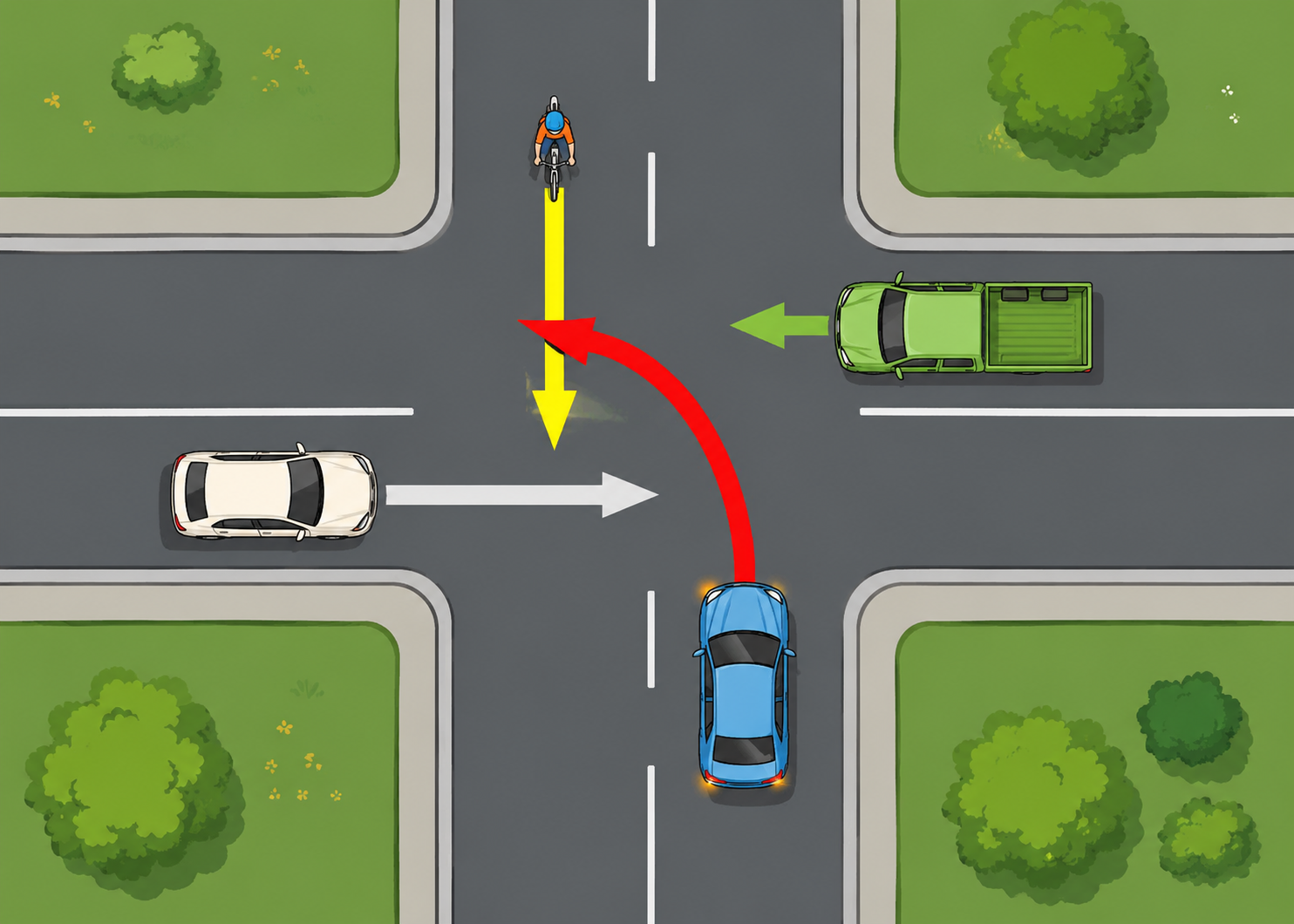
A driver making a left turn generally must yield to oncoming traffic.
A driver approaching a crosswalk must yield to pedestrians who are legally crossing.
Defensive drivers understand that even when another road user is legally required to yield, that person may make a mistake. Safety always takes priority over being technically correct.
Right-of-Way at Intersections
Intersections are among the most common locations for traffic conflicts.
Understanding intersection right-of-way rules helps drivers avoid hesitation and dangerous assumptions.
Controlled Intersections
Controlled intersections use:
Traffic signals
Stop signs
Yield signs
These devices establish who must stop and who may proceed.
Drivers should obey all signs and signals while remaining alert for violations by others.
Uncontrolled Intersections
An uncontrolled intersection has no traffic signal, stop sign, or yield sign.
In many jurisdictions, drivers must yield to vehicles approaching from the right.
Because local laws can vary, drivers should consult their state's driver handbook for specific requirements.
T-Intersections
At most T-intersections, traffic on the terminating roadway must yield to traffic traveling through the intersection.
Drivers entering the main roadway should wait until it is safe to proceed.
Four-Way Stop Right-of-Way Rules
Four-way stops rely on cooperation and predictable behavior.
General rules include:
First Vehicle to Arrive Goes First
The vehicle that arrives first generally has priority.
Simultaneous Arrival
If two vehicles arrive at the same time, the driver on the left typically yields to the driver on the right.
Turning Vehicles
When opposing vehicles arrive simultaneously and one intends to turn left, the left-turning driver generally yields to the vehicle traveling straight.
Defensive drivers make eye contact when possible and proceed cautiously even when they have priority.
Right-of-Way at Traffic Signals
Traffic signals simplify many right-of-way decisions, but drivers must still understand how different signal indications affect movement.
Green Lights
A green light allows traffic to proceed but does not eliminate the responsibility to yield when necessary.
Drivers should still watch for:
Pedestrians
Cyclists
Emergency vehicles
Vehicles running red lights
Yellow Lights
Yellow lights indicate that the signal is about to change.
Drivers should avoid accelerating through an intersection simply to beat the signal.
Red Lights
Drivers facing a red light must stop and remain stopped until permitted to proceed.
Certain jurisdictions allow right turns on red after stopping unless prohibited by signs.
Right-of-Way and Pedestrians
Pedestrian safety is a major component of right-of-way law.
Drivers should be especially cautious near:
Crosswalks
School zones
Parking lots
Residential neighborhoods
Pedestrians generally have priority in marked crosswalks and, in many locations, unmarked crosswalks at intersections.
Defensive drivers never assume pedestrians will act predictably.
Children, older adults, and distracted pedestrians may enter traffic unexpectedly.
Right-of-Way in Roundabouts
Roundabouts are becoming increasingly common because they improve traffic flow and reduce severe crashes.
The basic rule is straightforward:
Drivers entering a roundabout must yield to traffic already circulating inside it.
Defensive driving practices include:
Slowing before entry
Looking left for approaching traffic
Choosing gaps carefully
Avoiding sudden stops within the roundabout
Understanding these rules helps drivers enter smoothly without disrupting traffic flow.
Highway Merging and Right-of-Way
Highway entrance ramps create another common right-of-way situation.
Drivers entering a freeway generally must yield to traffic already traveling on the highway.
Successful merging requires:
Matching traffic speed
Checking mirrors and blind spots
Using turn signals
Selecting an appropriate gap
Drivers already on the highway may move over when safe, but the merging vehicle remains responsible for yielding.
Emergency Vehicles and Right-of-Way
Emergency vehicles responding with lights and sirens require special consideration.
Drivers should:
Remain calm
Signal intentions
Pull over safely when possible
Stop until the emergency vehicle passes
Failure to yield can create dangerous conditions and may result in significant penalties.
Common Right-of-Way Mistakes
Many collisions occur because drivers misunderstand or ignore right-of-way rules.
Common mistakes include:
Assuming Others Will Yield
Never assume another driver sees you or understands the rules.
Rolling Through Stop Signs
Failing to stop completely reduces reaction time and increases crash risk.
Forcing Merges
Aggressively entering traffic can surprise other drivers and create side-impact collisions.
Failing to Yield to Pedestrians
Pedestrian-related crashes often occur because drivers focus only on other vehicles.
Defensive Driving and Right-of-Way
Defensive drivers view right-of-way as a safety tool rather than a legal entitlement.
Key habits include:
Anticipating mistakes by others
Maintaining safe following distances
Watching for aggressive drivers
Scanning intersections carefully
Yielding when necessary to avoid conflict
The goal is not to prove who is correct. The goal is to prevent crashes.
Right-of-way rules create predictable traffic movement and reduce confusion where road users' paths intersect. Whether approaching a four-way stop, entering a roundabout, merging onto a freeway, or crossing paths with pedestrians, understanding when to yield helps drivers make safer decisions.
Defensive drivers combine knowledge of right-of-way laws with constant awareness and anticipation. By expecting mistakes, allowing extra space, and prioritizing safety over legal priority, drivers can reduce collision risk and contribute to safer roads for everyone.
Sources
Federal Highway Administration (FHWA), Roundabout Safety
National Highway Traffic Safety Administration (NHTSA)
Uniform Vehicle Code
State Driver Handbooks (California DMV, Texas DPS, Florida DHSMV, New York DMV)
American Association of Motor Vehicle Administrators (AAMVA)
Continue learning
Explore these related defensive driving resources: